Transmission damage vs. distribution damage: telling them apart in storm imagery
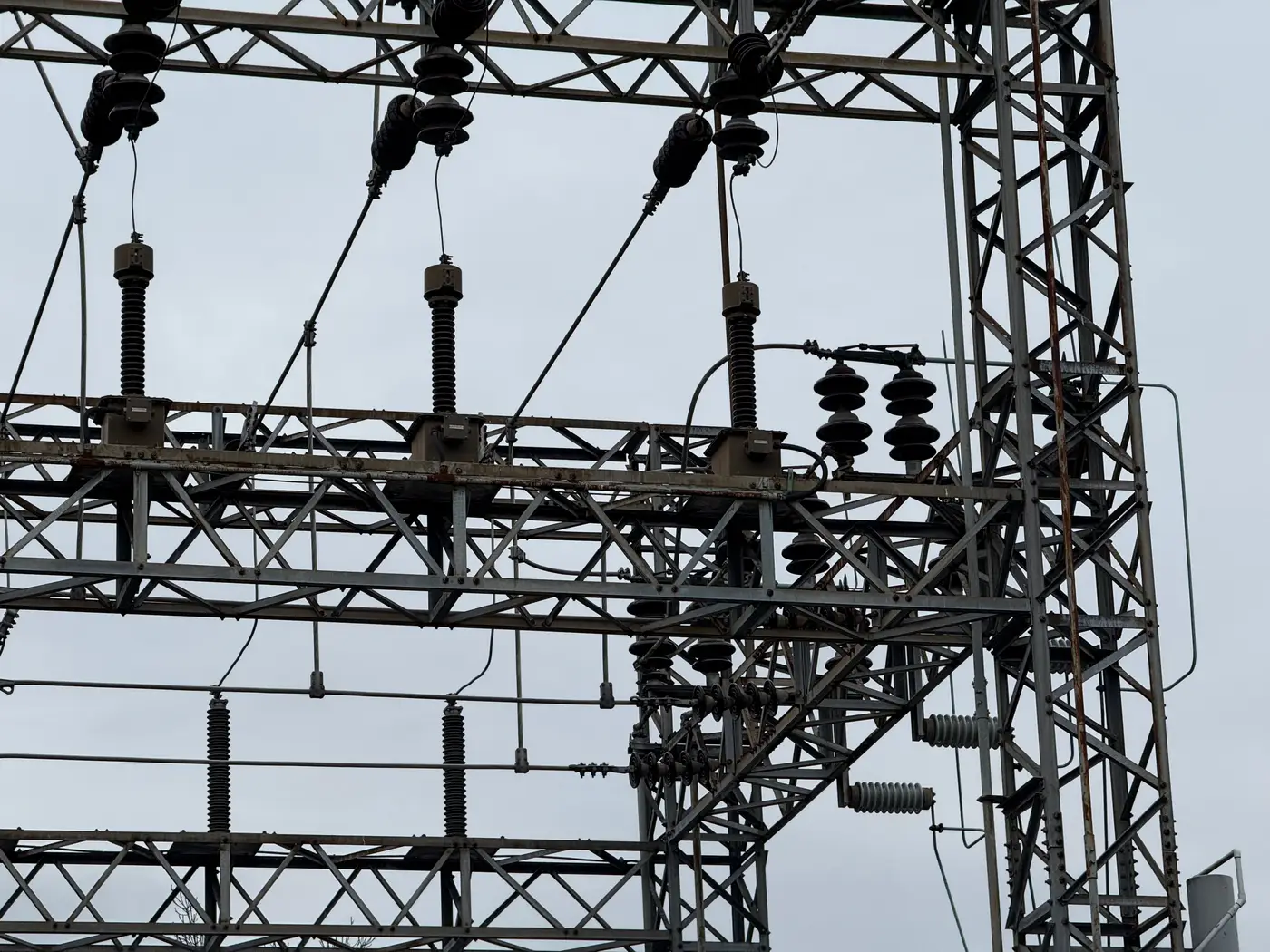
When the first comparison imagery comes back after a storm, the question your EOC is actually asking isn't "how bad is it." It's "where is it, and what voltage class." A snapped lattice tower and a broken crossarm on a wood pole both show up as damage, but they don't go on the same work order, and they don't get the same crew.
Reading structure type, not just damage
Transmission and distribution damage look different in imagery mostly because the structures look different, and that's your first sorting pass before anyone talks about priority.
Transmission runs on tall lattice towers or large steel/concrete monopoles, spaced wide, usually following a cleared right-of-way that cuts straight across terrain independent of roads. In post-event imagery, a transmission failure reads as a toppled or leaning tower, a collapsed span between two structures, or a conductor down across the ROW corridor. Because spans are long, one failure point can mean a mile or more of line out, and because towers are engineered for extreme loading, a toppled structure almost always means something severe happened there, a tornado track, a landslide, ice loading well past design.
Distribution is the wood-pole network threading along roads and through backyards, carrying your feeders and laterals at lower voltage. Distribution damage in imagery is messier and more scattered: snapped poles, pole top fires, crossarms hanging at an angle, spans draped into trees, whole blocks where the line just isn't where it was before. Vegetation is the usual culprit here, not structural failure, which is part of why distribution damage clusters so heavily along tree-lined corridors while transmission ROWs, kept clear by design, mostly don't.
If you're scanning a comparison pass and trying to tell the two apart fast: transmission damage is rare, isolated, and severe-looking even from altitude. Distribution damage is common, clustered, and often only visible as "the line isn't continuous anymore" rather than an obvious broken structure.
Why the distinction changes your sequencing
This matters past the OMS coding exercise. Transmission and distribution damage carry completely different restoration logic.
A transmission structure down usually means everything downstream of it, every substation and every feeder fed from that line, is dark until that one repair gets made. That's a single point of failure with a huge footprint, and it typically jumps to the top of the board regardless of how many trouble tickets distribution is generating elsewhere, because restoring it is what lets distribution crews start doing anything useful on the circuits behind it.
Distribution damage is where trouble-ticket volume genuinely helps, up to a point. Call volume tells you where customers are out, but it doesn't tell you whether that's one blown transformer or a mile of downed conductor, and it says nothing about circuits in low-population areas where tickets trickle in slowly even though the damage is extensive. A same-day comparison pass shows the feeder damage concentration before the trouble calls catch up, which lets crews get sequenced off the actual damage pattern on the ground rather than off who happened to call in first.
Most coordinators run the triage in three passes. First, confirm transmission structures are intact or pinpoint the failure point, since that gates everything behind it. Second, rank feeders for crew assignment using the damage concentration pattern across distribution. Third, let laterals and individual services fall in behind that. Mutual-aid crews specifically benefit from this, since they're walking in cold without the tribal knowledge of which substation feeds which neighborhood, and a damage map that already separates transmission failure points from feeder-level clustering gets them staged correctly on day one instead of day three.
None of this requires waiting until every circuit has been walked. It requires a pre/post comparison you can read the same day the imagery lands, which is the whole point of building restoration sequencing around imagery comparison instead of ticket volume alone. If your mutual-aid staging plan is still built entirely around which breaker fed the most calls, there's a faster way to point the first wave of trucks.